



November 11, 2015
As the core of optoelectronic device in the WAN, MAN or LAN application, fiber optic transceivers have developed various types along with the increasing in complexity. Take 10G transceiver module as an example, it has experienced developments from XENPAK, X2, XFP and finally realized with SFP+. Many users raised the questions related to the main difference between these optical modules. So, in the following part, we will provide some main tips about the difference among the XENPAK, X2, XEP and SFP +.
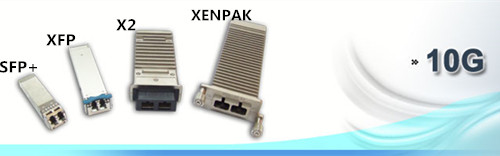
The first published XENPAK was by far the largest in physical size, which totally limited its popularity on the market. Many vendors then began to work on alternative standards. Finally in 2003, MSAs published another two 10G transceiver modules called X2 and XFP. X2 and XFP modules have been developed that support all of the high-power, long-distance applications once reserved for the larger XENPAK transceivers. But nowadays, SFP+ has gradually replaced the XFP and becomes the main stream of 10G transceivers markets. Why? The following part will answer you.
Both SFP+ and XFP are 10G transceivers, and can connect with other 10G transceivers. The main reason why SFP+ gain more market share than XFP is that SFP+ is more compact sized than XFP. The smaller SFP+ transfers the modulation functions, serial/deserializer, MAC, clock and data recovery (CDR) and EDC functions from the module to the motherboard on the card. In addition, cost of SFP+ is lower than XFP. Because XFP relies on a high-speed interface (10.3125Gbps), high-priced serializer/deserializer (SERDES) is required inside the switch to support it. They add an unacceptable cost to the base system of XFP. XFP complies with protocol of XFP MSA while SFP+ complies with IEEE802.3, SFF-8431, SFF-8432. SFP+ is the mainstream design currently.
Posted by: angelina at
02:54 AM
| No Comments
| Add Comment
Post contains 553 words, total size 6 kb.
35 queries taking 0.0514 seconds, 81 records returned.
Powered by Minx 1.1.6c-pink.

