



March 30, 2016
Recently 40GbE is gradually becoming the dominant Ethernet in the data center, which greatly promote the popularity of 40G components, especially 40G optical transceivers and 40G QSFP+ cables. 40G optical devices, featured by its unique specification, are designed to meet different interconnection applications in data center. It is known that 40G copper direct attach cables (Copper DAC), 40G Active Optical Cables (AOCs) and 40GBASE-SR4 QSFP+ optics are used in data center to achieve 40G interconnection. But according to IHS (a research company), 40G AOC won larger market share than the other two solutions in 2015 and the trend will keep going in 2016. So what makes it so popular in the data center? The following article will list several features of 40G AOC to give you a satisfying answer.
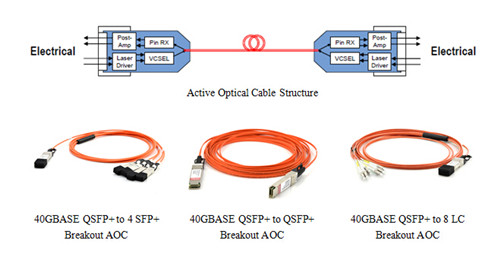
Before we come to the advantages of 40G AOC, let’s first have a brief overview of the 40G AOC cables. 40G AOC, is mainly used for short-range multi-lane data communication and 40GbE interconnect applications. It is a type of active optical cable terminated with 40GBASE-QSFP+ on one end, while on the other end, it can be terminated with QSFP+ connector, SFP+ connector, LC, SC, FC, and ST connector etc. The above picture shows three common types of 40G AOC.
40G AOCs have great advantages over 40G copper DACs like lighter weight, high performance, low power consumption, low interconnection loss, EMI immunity and flexibility. What’s more, when transmission distance reaches above 7 meters, 40G DAC is unable to reach. Just like QFX-QSFP-DAC-3M that is Juniper QSFP+ to QSFP+ passive copper cable with a link length of 3m. SR4 modules can support the same link length as AOC over OM3 cable, but has a better performance. Thus it is hard to tell which one is better than the other. The following part will illustrate from the next aspects—cost, Insertion Loss & Return Loss, Four-Quadrant Test and Digital Diagnostic Monitoring (DDM) to give you an objective solution about this.
40G AOCs cost lower than SR4 modules and do not need to use with extra fiber patch cables. In particular, 40G breakout AOCs, such as 40GBASE QSFP+ to 4 x SFP+ or 40GBASE QSFP+ to 8 x LC AOCs are cost-effective solutions to achieve 40G migration. For example, QSFP-4X10G-AOC1M is Cisco QSFP+ to 4SFP+ Active Optical Cable for a link length of 1 m. In additional, using AOCs, there are no cleanliness issues in optical connector and there is no need to do termination plug and test when troubleshooting, which can help user save more time and money.
Under the same case of transmission distance, the repeatability and interchangeability performances of SR4 module interface are not good as 40G AOC. What’s more, when different fiber optic patch cables plug into the module, it will have the different insertion loss and return loss. Even for the same module, this issue is existed. Of course, the related metrics such as the testing eye pattern will have no significant changes so long as the variation in and conformed to the scope. In contrast, an AOC with good performance is more stable and has better swing performance than SR4 modules in this situation. The following table shows the result of the repeatability test of SR4 module. From the data, it is clear to see that the repeatability performance of SR4 module is not stable.
The so called four-quadrant test is a testing under four combinations of input voltage and signal amplitude which are used to ensure the product to keep better performance even under the lowest and highest voltage and temperature situation. Four-quadrant test in wide temperature range is used to test the MTP/MPO interface and optical cable of AOC in order to ensure them not to be melted at a high temperature. Generally, the current products of AOC can all satisfy this demand. In addition, as an integration product, the performance of AOCs is more stable than SR4 modules which should be used with indeterminacy-performance MTP/MPO connectors. Unlike SR4 module, the quality index of AOCs is judged by electric eye pattern but not by light eye pattern.
DDM can help end users to monitor real-time parameters of the modules. Such parameters include optical output power, optical input power, temperature, laser bias current, and transceiver supply voltage etc. 40GBASE-SR4 QSFP+ modules with DDM function can ensure it’s optimal coupling by the ADC (analog to digital converters) value of real-time monitoring receiver when receive coupling. Thus, SR4 modules have better receiving sensitivity than AOC. However, at present, both SR4 module and AOC can not reach the function of real-time power monitoring.
To sum up, AOCs can avoid the influence of environment and vibration with integration and sealed design. Compared with 40G AOCs, DAC cables are more easier to manage as users do not need to do a series of termination plug and test on-site, but they do when using SR4 modules and patch cables.
Posted by: angelina at
02:52 AM
| No Comments
| Add Comment
Post contains 841 words, total size 6 kb.
March 26, 2016
In the past decades, the network speed has a great leap from 10Mbit/s in 1983 to today’s 40/100 Gbit/s. Thus new technologies have been developed to support the new transmission rate. Of which MPO technology with multifiber connector make the migration to 40/100 Gigabit Ethernet easier and more efficient, as it offers ideal conditions for setting up high-performance data networks in data centers to achieve greater bandwidth and handle future requirements. This article will briefly introduce the basics of MPO technology and its utilization in 40G Ethernet.
Shedding Light on MPO Connector
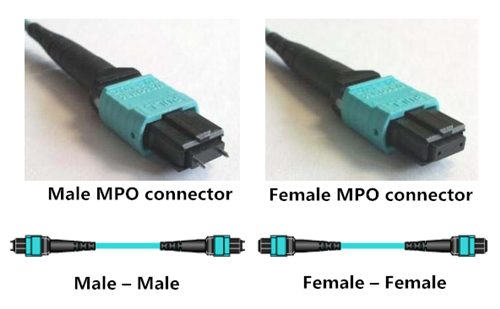
It is known that MPO connectors (known as multi-fiber push-on or multi-path push-on) can contact up to 72 fibers in a single connection. A connection must be stable and its ends correctly aligned, which is essential for achieving the required transmission parameters. A defective connection may even damage components and cause the link to fail altogether. MPO connectors are available in a female version (without pins), or a male version (with pins) as shown in the following picture. Noses and guide grooves (key) on the top side are the two other clearly visible features, which ensures the adapter hold the connector with the correct ends aligned with each other. Based on the placement of the key, two types of MPO adapters are available. One is "key-up to key-downâ€. It means the key is up on one side and down on the other. The two connectors are connected turned 180° in relation to each other. The other one is "key-up to key-upâ€. It means both keys are up. The two connectors are connected while in the same position in relation to each other.
Three Common Types of MPO Cables
MPO cable has the advantages of shorter installation times, tested and guaranteed quality and greater reliability. It has several different kinds of types.
Trunk Cables: trunk cables serve as a permanent link connecting the MPO modules to each other. They are available with 12, 24, 48 and 72 fibers. Their ends are terminated with 12-fiber or 24-fiber MPO connectors according to customer’s choice. These trunk cables like 12 fibers MPO trunk cable could help to create a simple, cost-effective 40G networking by installing a structured cabling system. MPO trunk cable requires greater care in planning but has a number of advantages, such as higher quality, minimal skew, shorter installation time, better protection, smaller volume of cable and lower total costs.
Harness Cables: harness cables provide a transition from multifiber cables to individual fibers or duplex connectors. For instance, 8 fibers 12 strands MPO harness cable has eight LC high fiber density connectors and a MPO connector, which is convenient for wiring and management system in 40G network with stable performance.
Y Cables: Y cables are generally used in the 2-to-1 version. A typical application is to join two 12-fiber trunk cables to a 24-fiber patch cord as part of a migration to 100 GbE. The rather rare version of 1 to 3 allows three eight-fiber MTP connectors to be joined to a 24-fiber permanent link, e.g. for migration to 40 GbE.
MPO Technology in 40 Gigabit Ethernet Cabling
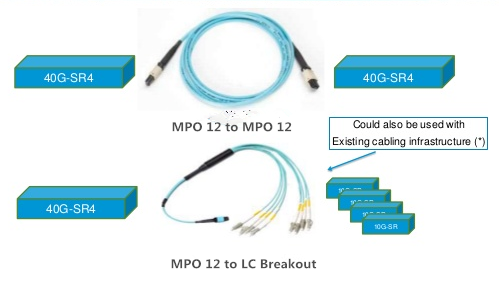
OM3 and OM4 fiber optic cables terminated with MPO/MTP connectors are dispensable for parallel optical connection. These are the ingredients for 40 GbE technology in a structured cabling environment. Parallel optical channels with multifiber multimode optical fibers of the OM3 and OM4 are used for implementing 40 GbE. The small diameter of the optical fibers poses no problems in laying the lines, but the ports suddenly have to accommodate four or even ten times the number of connectors. This large number of connectors can no longer be covered with conventional individual connectors. So 802.3ba standard incorporated the MPO connector for 40GBASE-SR4. 40GBASE-SR4 QSFP+ modules like QSFP-40G-SR4 can support link lengths of 100 meters and 150 meters, respectively on OM3 and OM4 multimode fibers with a 12-fiber parallel MPO/MTP female connector. We can achieve 10G to 40G migration up to 100m or 150m, respectively on OM3 and OM4 MTP to LC break out cable as shown in Figure 2.
Some Tips About MPO Connection
- Always use one male connector and one female connector plus one MPO adapter when creating a MPO connection (see the following picture).
- Never connect a female to a female or a male to a male. It should be connected with a male and a female as stated above. With a female-to-female connection, the fiber cores of the two connectors will not be at the exact same height because the guide pins are missing. That will lead to losses in performance. A male-to-male connection has even more disastrous results. There the guide pins hit against guide pins so no contact is established. This can also damage the connectors.
- Never dismantle a MPO connector. The pins are difficult to detach from a MPO connector and the fibers might break in the process. In addition, the warranty becomes null and void if you open the connector housing.
Summary
Featured by its high density, flexibility and reliability with scalable, upgradeable properties, MPO technology can better satisfy the increasing need to upgrade to 40/100G. Just don’t forget to follow the above connection rules.
Posted by: angelina at
02:06 AM
| No Comments
| Add Comment
Post contains 868 words, total size 7 kb.
March 24, 2016
What is the difference between SFP+ and SFP?
The pinouts of SFP and SFP+ connectors are identical. However, SFP has a maximum data rate of 5Gb/s whereas SFP+ is designed for 10Gb/s. The SFP receptacles and plugs are not as well impedance matched as SFP+ receptacles and plugs. Also SFP+ cable is designed for 10Gb/s whereas SFP cable may not be able to satisfactorily transmit that rate.
What is the distance supported by the SFP+ SR transceiver?
The supported distance is up to 300 meters depending on the quality of the multimode fiber (MMF) you use. Quality of MMF is listed as OM1 (up to 33 meters), OM2 (up to 82 meters), OM3 (up to 300 meters), and OM4 (up to 400 meters). Check with the supplier for the cable distance supported. Take GP-10GSFP-1S as an example, it is Dell Force10 10GBASE-SR SFP+ covering a distance of 300m over OM3 multimode cable.
Can I use SFP+ cables in SFP ports?
Yes, SFP+ cables are compatible to SFP ports and will work fine. SFP cables are not compatible to SFP+ ports. SFP+ receptacles have a mechanical feature to prevent engaging SFP plugs.
Do Fiberstore’s SFP+ direct-attach Twinx passive cables work with Cisco or other third-party switches?
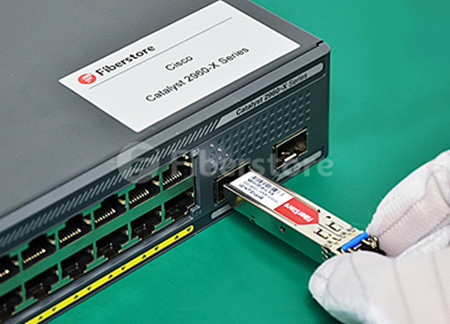
Fiberstore’s direct-attach SFP+ Twinx passive cables are fully compatible with the original brand like Cisco. For example, SFP-H10GB-CU3M is Cisco SFP+ to SFP+ passive copper cable from Fiberstore which is fully compatible with Cisco switch. The following image shows that our professional trained staff tests the compatibility and interoperability of each optics to make sure our customers to receiver the optics with superior quality.
What are the distances supported by cables to use with the 10GBase-T ports? Does Fiberstore offer these cables?
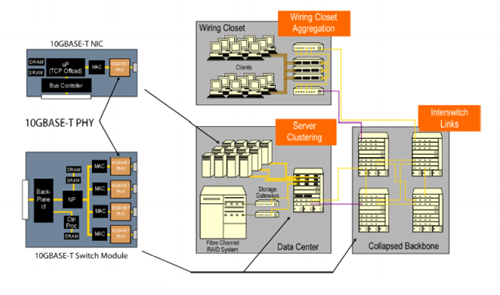
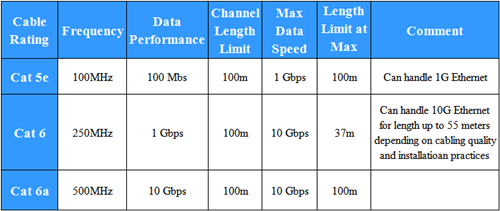
Data centers have a large installed base of Cat 5/6/7 twisted pair cables for the last decades—initially for 1000BASE-T and now for use with 1/10GBase-T infrastructure. Fiberstore does offer these cables since they are industry standard and widely available from us in various lengths and colors. Distances supported at 10 Gbps speed:
- CAT 6A and CAT 7 cables supporting 100 meters
- CAT 5e and CAT 6 cables supporting 55 meters
Do the SFP+ optical transceivers support 1 GbE operation?
Yes, they support 1GbE and 10 GbE dual rates and can be configured for 1 GbE.
Will the SFP+ optical transceivers auto-negotiate between 1 GbE and 10 GbE?
Auto-negotiation is not supported between the 10 GE and 1 GE speed. The transceiver must be manually configured to operate at 1 GE speed.
How do I use the SFP+ ports for 1000BASE-T?
You need to purchase Fiberstore’s SFP+ to 1000BASE-T Media Converter. (SFP+/Copper RJ45), part number FMC-1SFP/1RJ45-GB.
Is TwinX same as Twinax?
Yes.Does the Twinx copper cable plug directly into the NIC and the switch?
Yes, the copper cable has an SFP+ or QSFP connector on both ends of the cable that directly plugs into the corresponding ports of the switch and NIC.
Should I use optical transceivers with the SFP+ and QSFP direct-attach Twinx copper cables?
No. These are direct-attach Twinx cables and come with connectors that plug directly into the SFP+ port or the QSFP port of the switch/NIC on either end. Transceiver cannot be used.
What is the advantage of SFP+ Twinx copper cable?
It is a low-cost option for shorter distances up to 5 meters.
Is 10GBase-T same as 10GBASE-T?
Yes. 1GBase-T is shorthand for 1000BASE-T and 10GBase-T is same as 10GBASE-T; they are the twisted pair implementations of 1 GbE and 10 GbE respectively.
What are the SFP+ copper cables provided by Fiberstore?
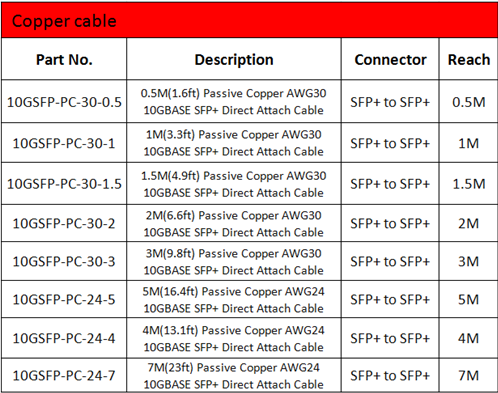
Posted by: angelina at
02:38 AM
| No Comments
| Add Comment
Post contains 604 words, total size 6 kb.
March 18, 2016
As the need for high data rate increases and the supporting optical devices becomes more affordable, many network designers are inclined to upgrade their infrastructure to higher-speed network like 10 Gigabit Ethernet. Currently 10G Ethernet is ubiquitous in data center. But do we really know about 10 Gigabit Ethernet? The following passage will provide some basic information to help you smoothly migrate to 10 Gigabit Ethernet.
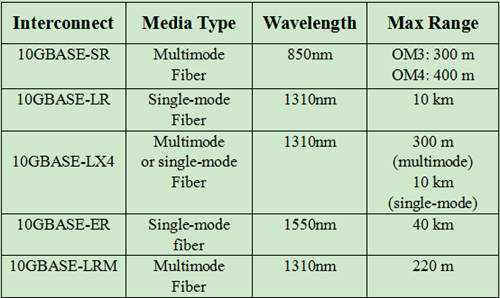
Fiber cable type, 10 Gigabit Ethernet physical interface and fiber optical transceiver module are the crucial components of 10GbE deployment. Table 1 demonstrates the standard fiber cables, physical interfaces, and transceiver modules that can be applicable to 10 Gigabit Ethernet.
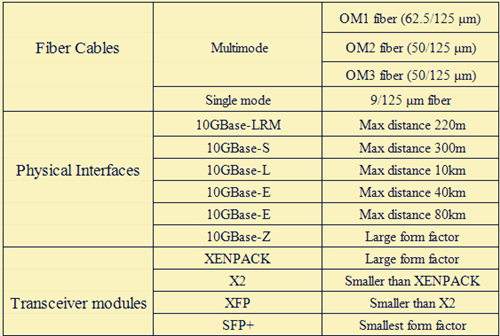
10G SFP+ transceiver, as an essential component to support 10G network, will be introduced in the next part. SFP+ supports speeds of 10Gbps or higher over fiber. The SFP+ product family includes cages, connectors, and copper cable assemblies. It is also similar to the performance requirements of SFF-8431 and also supports 8G Fiber Channel and 10G Ethernet applications. Take 46C3447 as an example, it is 10GBASE-SR SFP+ that can support a distance of 300m over OM3 cable.
10G Ethernet Fiber Cabling
As 10G cabling standards develop over time, there are three different copper cabling technologies for 10 Gigabit Ethernet. First, 10GBase-CX4 is the first 10 Gigabit Ethernet copper standard. It’s relatively economical and allows for very low latency. But the form factor is too large for high density port counts in aggregation switches.
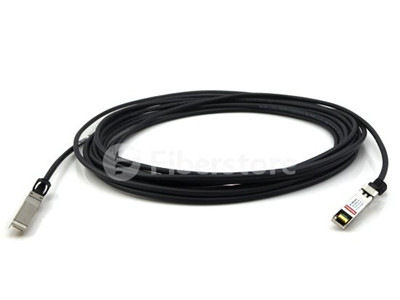
Second, Small Form-factor Plus (SFP+) is the latest standard for optical transceivers. 10 Gb SFP+Cu direct attach cables (DAC) directly connect into an SFP+ housing. It’s the best copper solution for servers and storage devices because it has low latency, small form factor and reasonable price.
Third, 10GBase-T is a fully IEEE compliant Ethernet transport technology standard, as defined by IEEE 802.3an-2006. 10GBase-T is to run 10 Gigabit Ethernet over CAT6a and CAT7 copper cabling up to 100 meters. 10GBase-T copper twisted-pair cabling can enable the earlier 10MB, 100MB and 1GB operation. However, 10GBase-T still needs to be improved on its price, power consumption and latency.
SFP+ Direct Attach Cables
SFP+ direct attach cables integrate SFP+ compatible connectors with a copper cable into a low-latency, energy-efficient, and low-cost solution. SFP+ direct attach cables offer the smallest 10 Gigabit form factor and a small cable diameter for higher density and optimized rack space in 10GbE uplinks and 10 Gigabit Fiber Channel SAN and NAS input/output connections. To use SFP+ direct attach cables can save you a lot compared with fiber optic solutions. And it can still provide lower latency and save up to 50% power consumption per port than other copper twisted-pair cabling systems. For example, JD097C is HP SFP+ passive copper cable that can support a link length of 3m.
SFP+ direct attach cables can also provide enhanced scalability and flexibility. The cables connect several servers or storage devices together in a single rack. Thus, it reduces the use of intermediate patch panels. And it’s easy to move racks or deploy one rack at a time since the cabling outside of the rack is limited to the main switch connection.
Conclusion
The increase in network bandwidth is driving the need to develop new products that will handle the network traffic and improve network performance. The 10GbE is presently underway to create a brighter future of fast-speed. And after years of development, there has been various different form factors and optics cable types introduced including XENPAK, X2, XFP, SFP+ and SFP+ cable.
Posted by: angelina at
03:11 AM
| No Comments
| Add Comment
Post contains 586 words, total size 5 kb.
March 16, 2016
As an indispensable component of network design, optical transceiver has been greatly improved in the past decades to cope with the increasing needs for speed and performance. From SFP, SFP+ to QSFP+, smart engineers will always promote a wise solution to realize higher-speed connectivity. For 40G network, 40GBASE-SR4 QSFP+ transceiver just like other modules can support conversion between optical signals and electrical signals of high data rate, making itself a commonly utilized interconnection solution in data center. And there is an alternative for 40G short-reach interconnection—AOC (active optical cable).
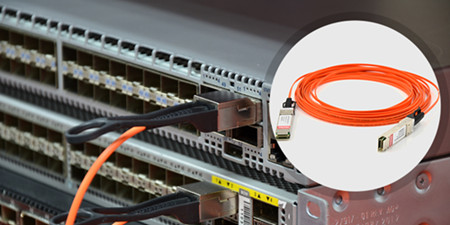
Usually, a 40G AOC cable contains a fiber optic cable terminated with QSFP+ connectors on both ends. Additionally, there is also other version of 40GBASE QSFP+ AOC with one end connected with a QSFP+ connector and the other end with several SFP+/XFP connectors., this is typically called fanout or breakout 40G AOC cable. 40GBASE QSFP+ to QSFP+ AOC has more advantages in transmission distance, bend radius, cable size, cable weight and cable management when compared with 40G copper DAC. Compared to 40GBASE-SR4 QSFP+ transceiver, 40G AOC avoids the need for fiber optic connectors and has a similar performance as the former, which seems to be a much more faster and easier methods for 40G interconnection. However, just like the coin has two sides, everything has its merits and demerits. To figure out which one is more suitable for your applications, a brief comparison between the two components will be offered in the following text. Figure 1 shows a 40GBASE AOC plugging into a switch.
Cost—Cost must be considered when choosing a solution for 40G interconnection. And the cost can be divided into two main aspects—material cost and the maintenance cost. The market price of 40G QSFP+ AOC is generally lower than 40G QSFP+ SR4 transceiver. To accomplish the connection, additional cost for patch cables should be considered for interconnection using 40G QSFP+ SR4 transceivers. For maintenance, as above mentioned, AOC is faster and easier which do not require much skills and saves labor. If the cost is limited, then AOC could be your choice.
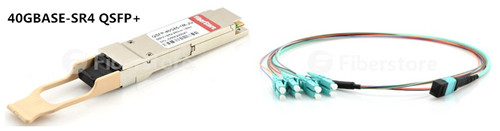
Transmission Distance—Optical signals are weaken as the transmission distance increases. Thus, to ensure the transmission quality, the transmission distance should be the first aspects to determine which one is better for your applications. Generally, 40G QSFP+ SR4 can support longer transmission distance than that of 40G QSFP+ AOC. For 40G transmission, if the distance is less than 100 meters, 40G QSFP+ AOC and 40G SR4 QSFP+ transceiver could have nearly the same performances. However, when the transmission distance is longer than 100 meters, the performance of 40G AOC will be limited. In this case, 40GBASE-SR4 QSFP+ will have a better performance. For example,QSFP-40G-SR4is Cisco 40GBASE-SR4 QSFP+ that can support a distance of 150m. Figure 2 shows a 40GBASE-SR4 QSFP+ and a OM3/OM4 MTP to LC break out cable, which provides a cost-effective solution for 40G interconnection for a distance of up to 150 m.
Reliability—Cables and connectors in data center inevitably need to be plugged out from devices like switches or servers for regular use and maintenance. With the actions of repeating plugging, the reliability and stability of a component became extremely important. The connectors of 40G AOC is factory pre-terminated, while QSFP+ SR4 transceivers is connected by additional MPO connectors and fiber optic cable. Thus, compared with QSFP+ SR4 transceiver, AOC is less affected by the repeating plug during daily use. In addition, there will be no insertion loss and return loss of 40G AOC, which can ensure its reliability furthermore. It has been proved that AOC has better reliability than that of transceivers.
Installation and Maintenance—Both 40G AOC and 40G QSFP+ SR4 transceiver are highly integrated components that provide increased port density and high data rate connection with great convenience during installation and maintenance. However, 40GBASE QSFP+ AOC is superior in this aspect. TakeQSFP-H40G-ACU7Mas an example, it is factory pre-terminated. Plug and play. It eliminates the process of linking two modules, which must be done for interconnection using 40G QSFP+ SR4 transceivers. Moreover, if there is a fault, you can just replace the AOC. However, the tests for the MPO connectors and cables are needed if 40G QSFP+ SR4 transceivers are used. Thus, AOC is easier and faster in installation and maintenance.
Posted by: angelina at
02:53 AM
| No Comments
| Add Comment
Post contains 792 words, total size 7 kb.
March 11, 2016
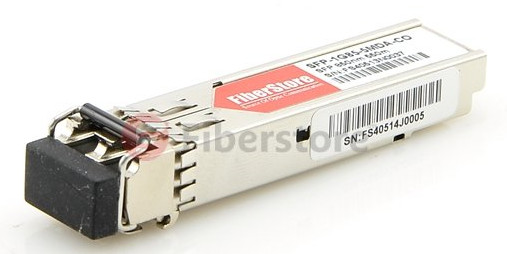
Ever since the Gigabit Ethernet has been applied in the telecom industry, the supporting devices like SFP transceivers have enjoyed popularity among more and more places. But there are several types of SFP transceivers available on the market. Which one suits you better? This article will illustrate three types of SFP transceivers—1000BASE-T SFP, 1000BASE-SX SFP, and 1000BASE-LX/LH SFP. I hope readers can learn something at the end of this text.
SFP (Small Form-Factor Pluggable) transceiver is a compact, hot-swappable, input/output device that is used for both telecommunication and data communications applications. As a major component required for Gigabit Ethernet connectivity, SFP interfaces a network device motherboard to a fiber optic or copper networking cable. With so many types of SFP transceivers, users are supposed to select the appropriate one for each link to provide the required optical reach over the available optical fiber type (multimode fiber or single-mode fiber).
Posted by: angelina at
03:28 AM
| No Comments
| Add Comment
Post contains 489 words, total size 5 kb.
March 09, 2016
Posted by: angelina at
02:39 AM
| No Comments
| Add Comment
Post contains 784 words, total size 8 kb.
March 03, 2016
To cope with the never-ending requirement for higher bandwidth, people are looking to migrate from 10G Ethernet to 40G Ethernet, whilst keeping their fiber infrastructure in compliance. However, the ability to migrate from 10G to 40G hinges on knowing the nature and length of the backbone cable. If you don’t know the overall length of the circuit, connector style (LC, 12 or 24 fiber MPO) or the fiber type (OM2, OM3, OM4, SM, etc.), you will trigger some mistakes during the migration. Then the following passage provides instantaneous access to detailed information about upgrading from 10G to 40G over multimode fiber.
Migrating from 10GbE to 40GbE for multimode fiber will require a lot more fibers and a different type of connector. Because 10G SR transceivers require 2 fiber strands per 10G link, 40G SR4 and CSR4 transceivers require a minimum of 8 fiber strands, and often 12 fiber strands in practice. The reason for this requirement is that 40G SR4 and CSR4 transceivers use 4 parallel fiber pairs (8 fiber strands) at 10Gbps each for a total of 40G full duplex. What’s more, 10G SR transceivers operate over dual-fiber multimode fiber (MMF) with LC connectors, and 40G SR protocols, such as SR4 and CSR4, operate over MMF ribbon with MPO connectors. As a result, 40G MPO-based SR4 transceivers cannot reuse aggregation fiber infrastructure built for 10G connectivity requiring fiber cabling infrastructure to be redesigned and replaced. The following text provides two cost-effective solutions for upgrading to 40G network.
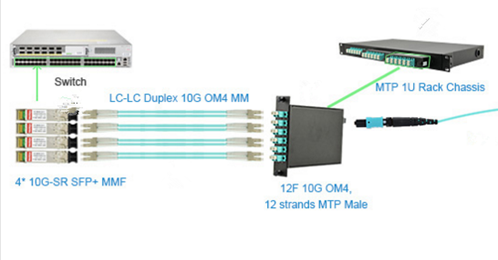
Scenario 1—if upgrading from 10G to 40G, one or more of the LC Duplex cassette(s) can be replaced with 12 MPO adapters. The MPO adapters are designed to fit in the same opening as the cassettes. This easy upgrade path uses the 8-fiber harness cable to connect to the 10G SFP+. From Figure 1, we can see that 4 10G SFP+ modules likeSFP-10GB-SR are connected with MPO adapter by MTP harness cable. It does not require any additional space and reuses the same patch panels. Additional 12-fiber cable assemblies (or any fiber counts in multiples of 12 fibers) are provided as needed for backbone or horizontal cabling.
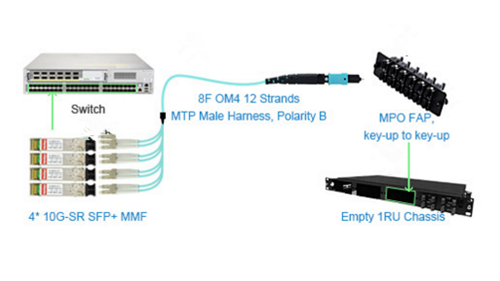
Scenario 2—if it is required to add some 40G connections while retaining the 10G connections, like Figure 2 shows, use one MPO/MTP LGX Cassette to connect four 10G SFP+ links. Then a Type-B female MPO/MTP trunk cable should be used between the cassette and 40G QSFP+ transceiver. QSFP+ transceiver likeQSFP-40G-SR4is needed here to provide a cost-effective solution for smoothly migrating to 40G connectivity.
- Media type—the type of cable and connector, such as LC or MPO, 12 or 24 strand fiber cable.
- Wiring pattern—12 and 24 strand cables won’t have the same wiring patterns, and it’s essential to track the wiring pattern coming out of trunk cable A and know whether it’s compatible going into trunk cable B.
- Performance level—whether it is a 40 or 100GbE cable, OM3 or OM4. This also provides details about the expected performance of a cable assembly.
- Insertion and cleaning—the number of insertions is used as an indicator of how often a particular fiber should be cleaned – if the fiber has been re-connected four or five times, it’s a good idea to clean it to remove dust or oil.
- Length of cable—the intelligent connectors enable the database to add up all the components on a circuit and see if the circuit exceeds the length budgets for 10, 40, or 100GbE. Even if the circuit segments are different lengths, it will base the length determination on the media type and expected performance level.
Posted by: angelina at
03:27 AM
| No Comments
| Add Comment
Post contains 659 words, total size 6 kb.
March 01, 2016
The accelerating growth of worldwide network traffic is forcing service providers, enterprise network managers and architects to look to ever higher-speed network technologies, just as the cabling technologies that support them are changing continually. Both IEEE802.3 standards and the associated 10G cabling technologies have assumed many forms in order to determine what 10G cabling strategy best suits a particular organization. The 10GbE standards outlined below help define and optimize the environment in which they operate and the cabling technologies over which they communicate. After going through this passage, you may find a suitable cabling for your 10G network.
- 10GBASE-SR—uses the lowest cost optics (850nm) to support 10GbE transmission over standard multimode fiber for distances of 33 and 86 meters. The SR standard also supports up to 300 meters using the new 2000MHz/km multimode fiber (laser-optimized). SR is the lowest-cost optics of all defined 10GbE optics. TakeJD092Bas an example, it can support a link length of 300m over OM3.
- 10GBASE-LR—uses higher cost optics (1310nm) than SR and requires more complex alignment of the optics to support single-mode fiber up to 10 km.
- 10GBASE-LX4—supports traditional FDDI grade multimode fiber for distances up to 300 meters using Coarse Wavelength Division Multiplexing (CWDM) at 3.125 Gbit/s. The LX4 standard also supports single-mode fiber for up to 10 Km. LX4 is more expensive than both SR and LR because it requires four times the optical and electrical circuitry in addition to optical multiplexers.
- 10GBASE-ER—uses the most expensive optics (1550nm) to support single-mode fiber up to 30 km. For 40km, the fiber-optic connection must be an engineered link.
- 10GBASE-LRM—ratified by IEEE, uses a technology called EDC (Electronic Dispersion Compensation). 10GBASE-LRM can provide a long distance solution based on multimode fiber and operates with a single wavelength of 1310nm.
- 10GBASE-SW, 10GBASE-LW, 10GBASE-EW—defined for use with a WAN PHY. These standards were defined to operate at the same baud rate as OC-192/STM-64 SONET/SDH equipment. They are the equivalent of the SR, LR and ER standards and support the same fiber cabling. LX4 does not have an equivalent WAN PHY standard.
Posted by: angelina at
03:23 AM
| No Comments
| Add Comment
Post contains 751 words, total size 7 kb.
32 queries taking 0.0596 seconds, 93 records returned.
Powered by Minx 1.1.6c-pink.

