



July 27, 2017
As data traffic increases, the requirements for high-bandwidth equipment also continue to rise. Many IT departments are looking towards devices like the 100G QSFP28 transceiver to achieve rapid data transmission. This small, high-density and high-speed product often comes as a standard part of 100G equipment. Therefore, these 100G optical transceivers have become the vital components in data centers. In this article, we will talk about the basic types of 100G QSFP28 optical transceivers, including SR4, PSM4, CWDM4 and LR4 versions.
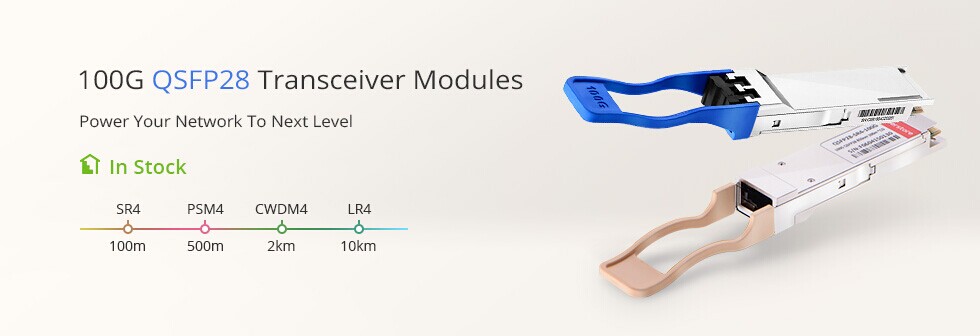
QSFP28 optical transceiver, designed in 100 Gb/s Ethernet network, which can provide high performance at low power. Firstly, these QSFP28 transceivers are fully compliant with all the latest Fibre Channel and Ethernet standards. And they have very high volumes, because it supports both 100G and 25G links. They allow maximum network capacity and help you quickly migrate to 100G transmission. Also, QSFP28 module is the smallest module available, and has the lowest power consumption among those that are capable of handling 100G traffic. So overall, these compact, high-density and high-speed modules can help to reduce the footprint of servers and lower power consumption while enabling more rapid data transmission.
FS has a wide range of 100G modules so that users can extend their choices when selecting a QSFP28 transceiver. These transceiver types include QSFP-100G-SR4-S, QSFP-100G-PSM4-S, QSFP-100G-CWDM4-S and QSFP-100G-LR4-S. And you can choose different brands of these types, covering Cisco, Juniper, Arista, Brocade, Extreme, Dell, Huawei, Ciena and Generic Compatible.
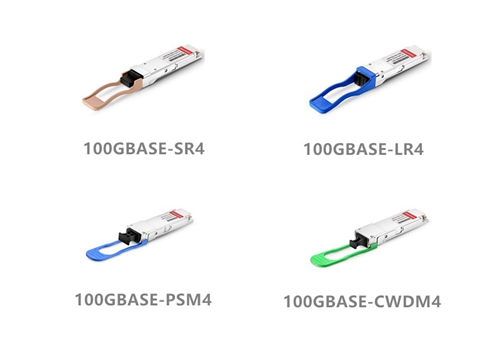
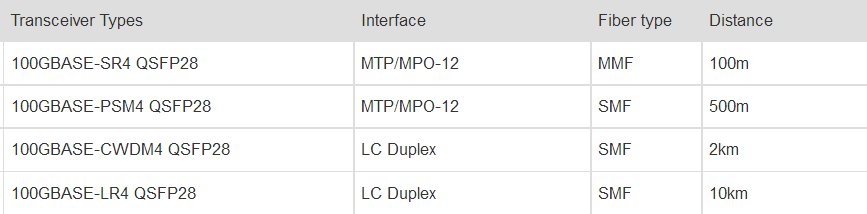
QSFP-100G-SR4-S: The SR4 version supports 100G Ethernet up to 70m on OM3 MMF and up to 100m on OM4 MMF. This 100G QSFP28 SR4 full-duplex optical module offers 4 independent transmit and receive channels, while each offers 25Gb/s operation for an aggregate data rate of 100Gb/s on 100 meters of OM4 multi-mode fiber. An optical fiber ribbon cable with an MTP/MPO connector can be plugged into the QSFP28 module, while electrical connection is achieved through an MSA-compliant 38-pin edge type connector.
QSFP-100G-PSM4-S:The PSM4 version is targeted to service the need of a parallel single mode infrastructure, as most customers currently pursue to the low cost solutions at 500m reach. The PSM4 offers 100G link length up to 500m. This 100G QSFP28 PSM4 defines a four lane 100 Gb/s optical interface to SMF media. Four identical and independent lanes are used for each signal direction. Moreover, the 100G PSM4 transceiver module provides a bi-directional electrical interface with the Host and a bi-directional optical interface with the fiber media. It performs transmit and receive functions that convey data between the Host and the media. All in all, the 100G PSM4 module define requirements for a point-to-point 100 Gb/s link over eight single-mode fibers up to at least 500 m.
QSFP-100G-LR4-S: The LR4 version supports connections up to 10km over single-mode fiber at a wavelength of 1310nm with duplex LC connectors. QSFP-100G-LR4-S supports 100GBase Ethernet rate up to 1km, and the signal is carried over four wavelengths managed within the device. The module converts 4 input channels of 25 Gbps electrical data to 4 channels of LAN WDM optical signals and then multiplexes them into a single channel for 100 Gbps optical transmission. Correspondingly, on the receiver side, the module de-multiplexes a 100 Gbps optical input into 4 channels of LAN WDM optical signals and then converts them to 4 output channels of electrical data. Besides, 100G QSFP28E-LR4 incorporates the electro-absorption modulated lasers (EML), EML have slightly different optical properties making them suitable for multi-rate traffic types.
QSFP-100G-CWDM4-S: The QSFP-100G-CWDM4-S optical transceiver is a full duplex optic module that provides a high-speed link at aggregated data rate of 103.13 Gbps over 2 km of single-mode fiber with duplex LC connectors. CWDM4 modules have the following common features: four optical transmitters, four optical receivers with signal detect,wavelength division multiplexer and de-multiplexer and a duplex optical connector for single-mode fiber. The transceiver four lasers with center wavelengths of 1271 nm, 1291 nm, 1311 nm and 1331 nm. The optical signals are then multiplexed into a single-mode fiber through an industry standard LC connector. On the receive side, four lanes of optical data streams are optically de-multiplexed by an integrated optical demultiplexer and transformed to an electrical CAUI-4 compliant output driver. This module features a hot-pluggable electrical interface, low power consumption and 2-wire I2C management interface.
All versions are fully compliant with the MSA standards and digital diagnostics functions are available via an MDIO interface, as specified by the QSFP28 MSA. These units operate off a single 3.3V power supply, and feature maximum power consumption of 3.5W (CWDM4, SR4, PSM4), or 4.5W/4.0W (LR4).
This next-generation QSFP28 provides increased port density and high performance for future data center and networking use. Most importantly, they can save you total expenditure in your date centers. For cost-sensitive data center customers, you can take your network to the next level with FS 100G QSFP28 optical transceivers, which offer easy compatibility with your existing switches and routers.
Posted by: angelina at
11:09 AM
| Comments (1)
| Add Comment
Post contains 836 words, total size 7 kb.
July 24, 2017
Today's data centers and telecommunication environments heavily depend on the foundation of the optical network. So what makes your optical network different to others? The design and performance of the pre-terminated optical cabling systems will contribute more to your data environments. It’s achievable with FS ultra high density solutions that take your data environments beyond the next level. This article will mainly talk about the ultra high density MPO/MTP cassette in data centers.
MPO/MTP cassette is a module, which is used for interconnect or cross connect if the distance between two devices is too long. As a pre-terminated fiber product, MPO/MTP cassette is loaded with 12 or 24 fibers and have LC or SC adapters on the front side and MPO/MTP at the rear. The cassettes come in a variety of connector styles and modes, including multimode, single-mode, SC, LC, etc. It is designed to reduce the installation time and effort associated with connecting a fiber optic network, as well as, improving overall network reliability through factory tested terminations. The cassette itself is comprised of four parts:
(1) MPO/MTP adapters in back
(2) MPO/MTP connectors to SC/LC fan out assembly inside the cassette
(3) SC, ST, MTRJ and LC adapters in the front
(4) The cassette module body can be configured to multiple manufacturers.

MPO/MTP Cassette Drawing
- High density pre-terminated fiber optic system
- Aluminum alloy shell protect the inner fibers effectively
- Improved reconfiguration during moves, adds and changes
- MPO/MTP cassettes provide faster and easier conversion between MPO/MTP and LC interfaces, which becomes the prefect choice for ultra high density MPO/MTP cabling system.
- MTP/MPO cassettes loaded into high-density fiber enclosures ensure data center space optimization, providing high fiber density and serviceability for high-performance data centers.
- MTP/MPO cassettes make the high-density fiber cabling system the most serviceable and manageable on the present market. They are used for optimum serviceability and manageability, providing the scalability to increase density as business demand evolves.
FHX-1MTP3LCQSMFA is a ultra high density MPO/MTP cassette, which is fitted with 12 fibers and has array adapters on the front side and MTP at the rear. It could be loaded in FHX series enclosures by plugging in the MTP connector through the back. From the front you can connect 3 LC UPC patch cords and patch your data to your switch, converter, or server. This cassette addresses today’s requirements for increasingly higher density levels. After that, FHX series MTP/MPO cassettes are used for high density pre-terminated optical cabling solutions offering industry-leading connector density. Each individual cassette of the whole series comes with test results that include insertion loss and return loss for both the MTP connector as well as the fan out to the SC or LC connections. What’s more, the cassettes come pre-loaded and pre-assembled to your specifications.
The following are main highights of FHX series MTP/MPO cassettes:
- Ultra high density pre-terminated fiber optic system
- Flat design maximizes space savings & improves flexibility
- Specially designed for quick loading and removal of modules
- US Conec MTP Adapter
Key up to key down type, which is fully compliant with IEC Standard 61754-7 and TIA 604-5.
- Ultra- thin Design
Ultra light, ultra- thin design provides great space savings in the network.
- The Flame Retardant Grade - ABS UL94 V0
Made by the halogen free, flame retardant material, which meets the ABS UL94 V0 Grade.
- The Special Buckle
Ready to install, easy operation, maximum operability and minimum downtime.
The system carries a high-density enclosure to optimize data center space, with innovative cable management, making the ultra high density fiber cabling system the most serviceable and manageable on the market today.


Method A Guidelines for Duplex Signals 10G Ethernet and Fiber Channel Applications
FS.COM provides a comprehensive solution of ultra HD MTP/MPO cassettes and the associated ultra high-density fiber enclosures. These MTP/MPO cassettes provide secure transition between MTP/MPO and LC or SC discrete connectors, used to interconnect MTP/MPO backbones with LC or SC patching. They allow for rapid deployment of high density data center infrastructure as well as improved troubleshooting and reconfiguration during moves, adds, and changes. Moreover, they enable users to take the fibers brought by a trunk cable and distribute them to duplex cable. I believe that ultra high density MPO/MTP cassettes can be your best solution to save space, time, and energy.
Posted by: angelina at
06:58 AM
| Comments (1)
| Add Comment
Post contains 797 words, total size 8 kb.
July 07, 2017
With the introduction of IEEE 802.3an 10GBASE-T, it was determined that a new category of twisted-pair cabling was required to guarantee performance of the 10G network. Most of the time, Cat5e is suitable for 1G network. But now, many streaming media applications can be seen everywhere, the demands for faster data rates will be increased. These new applications are really pushing the limits of Cat5e cabling. Therefore, Cat6 will be a successful choice to deploy a new cabling system. So what is Cat6? What is the difference between Cat5e and Cat6? And so on. This article will provide simple answers to these questions.
A: Cat6 is a standardized twisted pair cable for Ethernet and other network physical layers that is backward compatible with the Cat5/5e and Cat3 cable standards. Cat6 cables have a tighter twist in the cables allowing for two-way communication, which eliminate some or all cross talk with other cables. The cable standard provides performance of up to 250 MHz and is suitable for 10GBASEâ€T / 100BASEâ€TX and 1000BASEâ€T / 1000BASEâ€TX Gigabit Ethernet. In addition, the Cat6 cable is terminated in either the T568A scheme or the T568B scheme. So far, the T568B Scheme is the most widely used method of terminating patch cables.
A: First, the cable construction. It is a observable difference. The diameter of Cat6 cables are in the range of 0.21 to 0.25 inch (5.3 - 5.8 mm), while Cat5e cables are in the range of 0.19 to 0.22 inch (4.8 - 5.5 mm). The reason is that Cat6 cables are manufactured with larger copper conductors and an internal divider that serves to separate the pairs within the cable and reduce cross-talk noise.
Second, the speed. As I mentioned before, Cat6 cables are suitable for 10GBASE-T, or 10G Ethernet, while Cat5e cables support only up to 1000BASE-T, or 1G Ethernet. In addition, Cat5e and Cat6 have different distance under different transmission rate. Both Cat5e and Cat6 can allow 1G Ethernet up to 100 meters, but Cat6 has a lower max length (55 meters) and provides 33 meters in high cross talk conditions when used for 10GBASE-T (10 Gigabit Ethernet).
Third, the frequency. Cat6 offers the available bandwidth up to 250 MHz, while Cat5e is up to 100 MHz. The performance improvements of Cat6 include better insertion loss, near end cross talk, return loss, and equal level far end cross talk, which allow higher reliability for current applications and higher data rates for future applications.
Fourth, except the cable construction, speed and frequency, Cat6 has a tighter twist in the cables, which allows for two-way communication on each pair of wires, while Cat5e does not allow this feature.

A: The answer is yes. Today, the choice for Cat6 tends to be an economic one. Although the installed cost for Cat6 cabling can be about 20 % higher than Cat5e, the benefits of Cat6 could overweight Cat5e in terms of bandwidth, transmission performance, reliability and application support. Besides, Cat6 is backward compatible to Cat5e, which makes it very easy for customers to choose Cat6 in their networks. So Cat6 will replace Cat5e in one day.
A: The installation of Cat6 is the same as Cat5e very much. However, there are some notes that should pay more attention to. The larger physical cable diameter needs to be taken into account when deploying the cable pathways. When terminating Cat6, it is very important to ensure that the pair twists are maintained right up to the point of termination. Equally, it is important to follow manufacturer’s instructions for terminating connectors. A poor termination can significantly reduce performance or cause test failures in the field.
A: There is no short length limit. The Cat6 standard is intended to work for all lengths up to 100 meters. According to the ANSI/TIA/EIA-568-B.1, the consolidation point should be located at least 15 meters away from the telecommunications room, in order to reduce the effect of connectors in close proximity.
A: Yes, Cat6 will be very effective in the residential market to support higher Internet access speeds. The better balance of Cat6 will make it easier to meet the residential EMC requirements compared to Cat5e cabling. What’s more, the growth of streaming media applications to the home will increase the need for higher data rates which are supported more easily and efficiently by Cat6 cabling.
What we can make conclusion is that Cat6 is the smartest choice for 1G/10G copper cabling system implementations. In the long term, the performance improvements offered by Cat6 will produce an extended operational life span and protection of your Cat6 infrastructure investment.
Posted by: angelina at
06:07 AM
| No Comments
| Add Comment
Post contains 811 words, total size 6 kb.
35 queries taking 0.0656 seconds, 84 records returned.
Powered by Minx 1.1.6c-pink.

