February 25, 2016
What Does DOM Mean for a SFP Transceiver?
If you take a look at the description of a SFP transceiver module, you will see the "DOM support†appeared in the product details. What does it mean? In fact, DOM or Digital Optical Monitoring as the words implies, is used for monitoring some parameters of the transceiver, which can help to identify the location of the fiber link failure, simplify maintenance, improve system reliability. Obviously a SFP with DOM function is high-ender than one without it. This is why most of modern optical SFP transceivers support DOM functions. To have a further understanding of DOM, some detailed information will be introduced in the following passage.
What Is DOM Support?
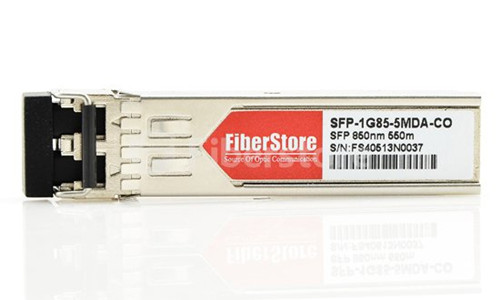
As noted before, DOM is a feature allowing users to monitor parameters of the transceiver module in real-time, such as temperature, supply voltage, laser bias current as well as transmit and receive optical power. Measurement of these parameters can help network administrators to check and ensure that the module is functioning correctly. Nowadays SFP transceivers are using DOM to perform transceiver monitoring and troubleshooting operation. For example, the DOM function that Cisco
GLC-SX-MMD transceiver support can assist network designers in detecting and digitizing parameter signals on circuit board in the inside of this Cisco SFP module. But how to generate DOM function for your optical transceiver?
How to Use DOM
In order to be able to take advantage of DOM capability, both the device and the platform must support the feature. When the transceiver module is DOM-enabled, a minimum software version may be required to support the feature in each platform. And there are five steps you should follow when conducting the DOM function in a SFP module:
1. Enable example: Router> enable (Enables the privileged EXEC mode. Enter your password if prompted.)
2. Configure terminal example: Router#configure terminal (Enters the global configuration mode.)
3. Transceiver type all example: Router (config) #transceiver type all (Enters the transceiver type configuration mode.)
4. Monitoring example: Router (config-xcvr-type) #monitoring (Enables monitoring of all optical transceivers.)
5. Monitoring interval example: Router (config-xcvr-type) #monitoring interval 500 ((Optional) Specifies the time interval for monitoring optical transceivers. Valid range is 300 to 3600 seconds, and the default value is 600 seconds.)
To sum up, these three commands can used to turn on/off DOM for all transceivers type in the system:
- Router (config) #transceiver type all
- Router (config-xcvr-type) #monitoring
- Router (config-xcvr-type) #end
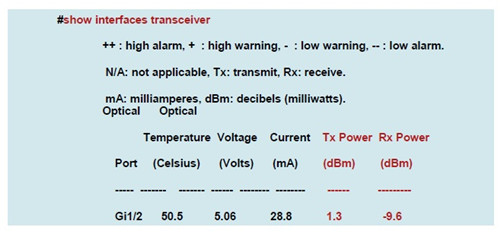
Once enabled, DOM can be accessed via CLI using "show interface transceiver commandâ€. Off all the five values, two mostly used and relevant values are TX and RX power, temperature is also used sometimes. The operating range of these three values is unique across all modules and is available in the data sheet.
Additional Information
DDM and RGD are another two common abbreviations appeared in transceiver modules’ product specifications. So, what does they refer to?
DDM, short for Digital Diagnostics Monitoring, is a technology used in SFP transceivers in order to give the end user the ability to monitor real-time parameters of the SFPs. Such parameters include optical output power, optical input power, temperature, laser bias current, and transceiver supply voltage etc.
What Is a 'Rugged' (RGD) Transceiver Module?
These are enhanced transceiver modules which have been designed for greater durability, and can operate under more extreme conditions. Rugged transceivers may feature enhanced ESD protection, and extended operating temperature range. Rugged transceiver modules often have "-RGD" in their product number to assist in their identification.
Conclusion
After going through this passage, you may have a better understanding of DOM. Before purchasing the SFP transceiver, you should read all the product details carefully because not all the transceivers can support DOM like
GLC-LH-SM. Find a reliable vendor will avoid those problems.
Reference:
Posted by: angelina at
02:57 AM
| No Comments
| Add Comment
Post contains 623 words, total size 7 kb.
February 20, 2016
How Transceiver Help Support Big Data
Optical transceiver market is growing rapidly and expected to be worth billion dollars. Network designers confirm that big data technology in data center is a major contributor to this growth. A transceiver, as a necessary component in data center can help executives to get their data in real-time, thus people can make immediate decisions. This is why it’s so important to be aware of how transceivers help to support big data.
Transceivers Are Supporting Big Data in Data Centers
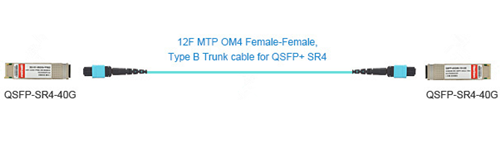
Big data technology nowadays is the overwhelming trend because people can have access to data at all times and at everywhere. Greater bandwidth is necessary to support video and other types of data. Recently, 40GbE network has replaced 10G Ethernet network and has been used worldwide. 40GbE network is typically comprising of a pair of transceivers connected with cable. The transceivers, in turn, are plugged into either network servers or a variety of components including interface cards and switches. Transceivers are optical equipment in ensuring that the data is transmitted securely, expeditiously, and accurately across the fiber. To make sure the network capacity, optical transceivers, fiber patch cables, and switched are required to accomplish this goal. Take 40GbE network as an example, a 40G QSFP+ SR4 transceiver (
QSFP-40G-SR4) needs a Type-B female MPO/MTP to female MPO/MTP cable to realize the 40G connectivity. Figure 1 shows two 40GQSFP+ SR4transceivers connected by a MTP female cable.
Transceivers Facilitate High Speed Data Transfers
By transmitting data at 10 Gbit/s or 40 Gbit/s, optical transceivers can facilitate high speed data transfers that can ensure that data arrives quickly. There are many types of transceivers and all are capable of handling fast transmission rates, such as SFP, SFP+, XFP, QSFP+, CFP, etc. But to tell the truth, each form factor has its unique usage and can support different bandwidth. Every organization that wants to achieve faster transmission times will choose to high quality transceivers for their designs.
40G QSFPis largely favored by designers as it can provide high-density 40G Ethernet. Optical transceivers that are capable of handling fast speeds can help with downloads and high and low bandwidth video transmission. If you’re a manager that needs to avert crisis immediately and you want to make a decision based upon real-time data, high-speed data transmissions speeds are necessary. Just remember to select the most suitable transceivers for your infrastructure.
Data Centers Benefit From The Use of Transceivers
Data centers are where companies store the barrage of data that comes from their offices. The information is usually stored in the cloud where employees and executives can access the information at any time they need. The data centers need to transmit data accurately, securely, and rapidly. Transceiver technology can facilitate the transmission process. This technology will help to fuel the growth by increasing the speed of data transmission across the fiber. Executives can make faster decisions and maintain a competitive advantage in the area.
Summary
Transceiver technology is just one component in the grand scheme of design related to big data, and there are other necessary components we shouldn’t neglect. But without transceivers, it would not be possible to transmit data at fast rates and over significant distances. Thus purchasing the right optical transceiver for your business is essential.
Posted by: angelina at
03:21 AM
| No Comments
| Add Comment
Post contains 545 words, total size 5 kb.
February 18, 2016
40GbE – A Logical Step for 100GbE
2010 witnessed the ratification of 40GbE and 100GbE standard, which is a great breakthrough of telecommunication industry. This standard is developed by the IEEE 802.3ba Task Force to support sending Ethernet frames at 40 and 100 gigabits per second. They also address physical layer specifications for communication across backplanes, copper cabling, multimode fiber and single-mode fiber. In 2016, 40GbE will continue to enjoy its popularity of aggregation links in data center networks. With four times the capacity and the ability to cost-effectively migrate to 100GbE, 40GbE is regarded as the next logical step in the evolution of data network. 40GbE has been utilized worldwide, and 100GbE will become popular soon, we can’t help looking forward to the advent of higher-bandwidth network like 400GbE.
A Closer Look at 40GbE
40GbE network, just like 1GbE or 10GbE network layer, is mainly comprising of a pair of transceivers connected by a cable. The transceivers, in turn, are plugged into either network servers or a variety of components including interface cards and switches. The next part will provide some detailed information about these components of 40GbE network.
40GbE Optical Transceiver
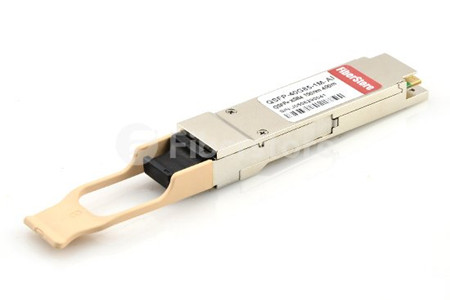
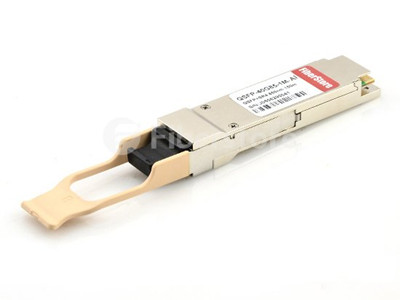
40GbE transceivers are being developed along several standard form factors. Of all the 40G transceivers, the QSFP (quad small-form-factor pluggable) is the most commonly used 40G transceiver module on the market for its similar size to the CXP and providing four transmit and four receive lanes to support 40GbE applications for optical fiber and copper cables. Engineers anticipate that when lane rates increase to 25Gb/s, the future role for QSFP may be to serve 100GE. The following picture shows a
Arista QSFP-40G-SR4transceiver module.
40GbE Cabling
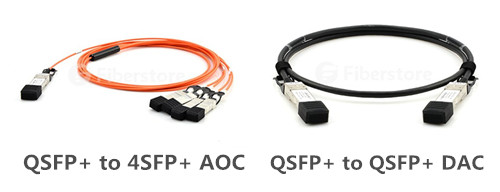
Cabling for 40GbE, summarized in the previous passage, can be optical fiber or copper. The supportable channel length depends on the cable and the transceiver type. Transceivers to send light across fiber are reassuringly expensive, the higher the bandwidth and the longer the distance required, the pricier the module. There are two basic cabling options for 40G network—DAC or AOC. For the passive and active direct-attach copper (DAC) cables, it allows lower-cost short-reach capability for top-of-rack (ToR)-to-server connectivity. However, DAC cables are limited to transmission distance, and coaxial cable can be stiff and bulky in high-density deployments. Active optical cable (AOC) allows lower-cost short-reach capacity with more flexible cabling but reconfigurations of length or failed transceiver requires replacement of entire assembly. The following image shows a
QSFP-4X10G-AOC10M(left) and QSFP-H40G-CU5M (right).
Connector Type
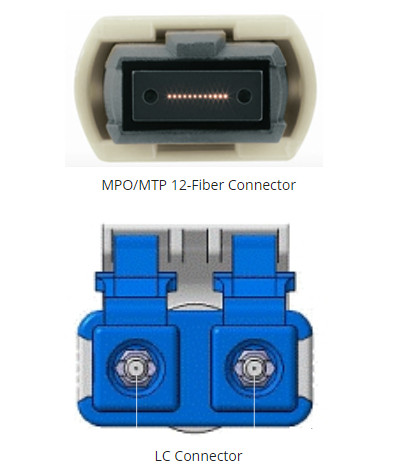
With regards to connectors, the significant change from 10G to 40G is the use of MPO (Multi-Fiber Push On) type connectors at the multimode transceivers to support the multi-fiber parallel optics channels. The traditional LC duplex connector that SFP+ modules use has a ceramic ferrule on each connector, which is aligned in an adapter panel with the use of a ceramic alignment sleeve. However, the MTP/MPO connector uses a pinned and non-pinned connector alignment system, making it imperative to always maintain the correct pinning. For data center environments operating at 40GbE or 100GbE, OM3 and OM4 multimode cabling is generally recommended because its reach supports a wider range of deployment configurations compared to copper solutions, and the cost is lower compared to single-mode solutions.
Use Parallel Optics
Traditionally, the Ethernet standard preferred to use duplex fiber cabling with each channel using one fiber to transmit and the other to receive. However, the 802.3ab standard requires multiple lanes of traffic per channel. To realize this, the 40/100GbE standard uses parallel optics. For example, the 40GbE specification calls for a 12-fiber cabling solution with each channel featuring four dedicated transmit fibers and four dedicated receive fibers. The middle four fibers remain unused, or dark. While the 100GbE solution specifies 24 fibers divided into two 12-fiber arrays with one array dedicated to transmit and the other dedicated to receive. In each array, the middle ten fibers are dedicated to traffic while the two fibers on either end remain dark.
Conclusion
The ratification of 40GbE/100GbE Ethernet standard is not only the breakthrough of telecom industry, but a good news for human beings for helping people to lead a better digital life. Installing 40GbE network has been proven to be a cost-effective method. By simply deploying a CFP form factor transceiver, then you can enjoy the fast internet speed of 100GbE. 40GbE and 100GbE has already upon us, can 400GbE be far behind.
Posted by: angelina at
03:15 AM
| No Comments
| Add Comment
Post contains 726 words, total size 7 kb.
February 15, 2016
Three Common Types of HP 40G Modules
40G QSFP+ (quad small form-factor pluggable plus) module is a compact, hot-pluggable transceiver used for data communications applications. It is the high-density interface addressing deployment of high-performance computing in data center clouds by using four independent optical transmit and receive channels. Compatible HP QSFP+ transceivers provided by Fiberstore are third-party optical modules certificated to be fully compatible with HP Switch/Router product line. HP compatible QSFP+ transceivers have the same functionality with the original. HP 40GBASE QSFP+ modules in this article are mainly introduced in three different types—40G LR4 QSFP+ transceiver, 40G SR4 QSFP+ transceiver and 40G CSR4 QSFP+ transceiver.
HP 40GBASE-LR4 QSFP+ Transceiver
The 40G LR4 QSFP+ transceiver together with the LC connector can support an optical link length up to 10 kilometers over single-mode fiber. 40G LR4 QSFP+ transceivers offer 4 independent transmit and receive channels. In order to realize the function of transmitting 4-channel signals over single-mode fiber, this transceiver has to introduce MUX/DEMUX to multiplex/de-multiplex optical signals. For example, HP 40GBASE-LR4 QSFP+ transceiver enables high speed 4x10G operations. It is compliant with QSFP+ MSA and IEEE 802.3ba, which primarily enables high-bandwidth 40G optical links with duplex LC connectors and can also be used in a 4x10G module for interoperability with 10GBASE-LR interfaces.
HP 40GBASE-SR4 QSFP+ Transceiver
The 40G SR4 QSFP+ transceiver compatible with the 802.3ba 40GBASE-SR4 standard, provides a 40G optical connection using MPO/MTP fiber ribbon connectors. Unlike the 40G LR4 QSFP+ transceiver, this transceiver are used together with multi-mode fiber, supporting with a link length up to 100 meters on OM3 cable and 150 meters on OM4 cable. HP 40GBASE-SR4 QSFP+ transceiver supports link lengths of 100m and 150m, respectively on OM3 and OM4 multi-mode fiber at a wavelength of 850nm. It primarily enables high-bandwidth 40G optical links over 12-fiber parallel fiber terminated with MPO/MTP multifiber connectors and can also be used in a 4x10G module for interoperability with 10GBASE-SR interfaces. The following picture shows a HP
JG325Bcompatible 40GBASE-SR4 QSFP+ transceiver.
HP 40GBASE-CSR4 QSFP+ Transceiver
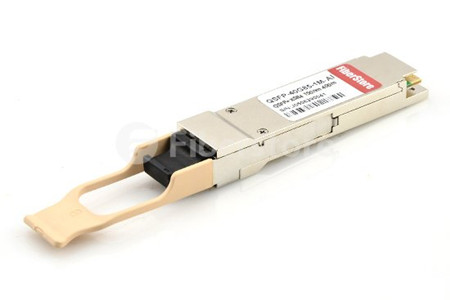
40GBASE-CSR4 QSFP extends the reach of IEEE 40GBASE-SR4 interface to 300 and 400 meters on laser-optimized OM3 and OM4 multi-mode parallel fiber, respectively. Each 10-gigabit lane of this module is compliant to IEEE 10GBASE-SR specifications. This module can be used for native 40G optical links over 12-fiber parallel cables with MPO/MTP female connectors or in a 4x10G mode with parallel to duplex fiber breakout cables for connectivity to four 10GBASE-SR interfaces. Fiberstore compatible HP 40GBASE-CSR4 QSFP module is optimized to guarantee interoperability over the complete specification range of 10GBASE-SR. Take HP
JG709Aas an example, it is intended to support up to 300m on multi-mode fiber at a wavelength of 1310nm. The image below shows a HP JG709A compatible 40GBASE-CSR4 QSFP+ transceiver.
Recommended Information
Fiberstore 40G QSFP+ solution offers customers a wide variety of high-density and low-power 40 Gigabit Ethernet connectivity options for data center, high-performance computing networks, enterprise core and service provider applications.
Posted by: angelina at
08:06 AM
| No Comments
| Add Comment
Post contains 487 words, total size 5 kb.
36kb generated in CPU 0.0263, elapsed 0.0685 seconds.
32 queries taking 0.0521 seconds, 83 records returned.
Powered by Minx 1.1.6c-pink.