



January 15, 2016
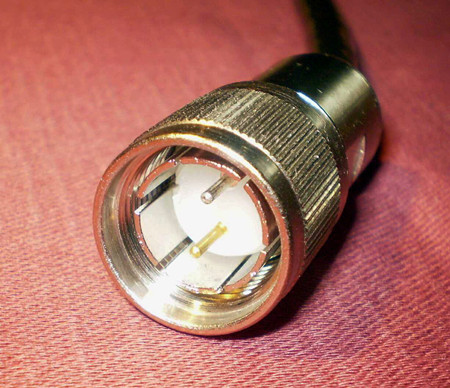
Optical fiber cabling had gone through rapid development over recent years and maintained its leading role in telecom field. While twinax cable still remained a good way to access the networking industry trends over the last three decades and presented the highest longevity among all media. Twinax cable (see in following Figure) is a type of cable similar to coaxial cable that has two inner conductors instead of one. And owing to its cost efficiency, it is commonly used in short-range high-speed differential signaling applications. Currently there is a twinax cable which comes in either passive or active copper cable. So what is the difference between them? Today’s passage will provide a satisfying solution to you.
When the distance between connection points exceeds 5m, it is highly recommended to use active cables to ensure signal is transferred all the way through. The downside is that they are more expensive and use more power. The upside is that you don't have to worry about distance (up to 300 meters) and, perhaps more importantly, you don't have to worry about which vendor’s cable you use and the signal is improved and gives peace of mind by creating a trustworthy connection. In regards to active versus passive twinax cables, it depends on what you are connecting together.
QSFP to 4SFP+ copper breakout cables are suitable for very short distances and offer a very cost-effective way to connect within racks and across adjacent racks. TakeQSFP-4SFP10G-CU1Mas an example, this breakout cable connects a 40G QSFP port and four 10G SFP+ ports of Cisco switches and operates at a link length of 1m. While a QSFP+ to QSFP+ passive copper cable consists of a cable assembly that connects directly into two QSFP+ modules, one at each end of the cable. This cable use integrated duplex serial data links for bidirectional communication and is designed for data rates up to 40Gbps. There are various QSFP+ to QSFP+ passive copper cables branded by famous brands, like Cisco, HP, Juniper, Brocade, etc. The following picture shows a CiscoQSFP-H40G-CU3MCompatible QSFP+ to QSFP+ passive copper cable.

Posted by: angelina at
03:28 AM
| No Comments
| Add Comment
Post contains 662 words, total size 6 kb.
35 queries taking 0.1428 seconds, 81 records returned.
Powered by Minx 1.1.6c-pink.

