



November 02, 2015
With the massive applications of bandwidth-related products in telecommunication networks, people may encounter a dilemma of whether to deploy fiber-based or copper-based infrastructure. Limited budget always comes as an essential factor deciding people’s choice, under this circumstance, copper cabling or 1000BASE-T proves to be a nice and cost-saving method.
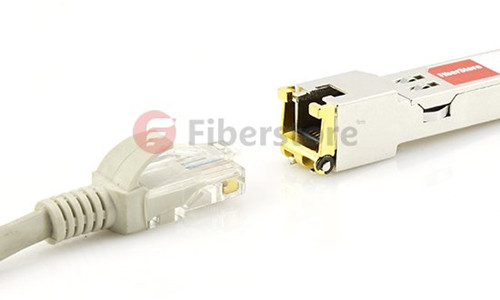
1000Base-T is a type of gigabit Ethernet networking technology that uses copper cables as a medium. 1000Base-T uses four pairs of Category 5 unshielded twisted pair cables to achieve gigabit data rates. The standard is designated as IEEE 802.3ab and allows 1 Gbps data transfer for distances of up to 330 feet.
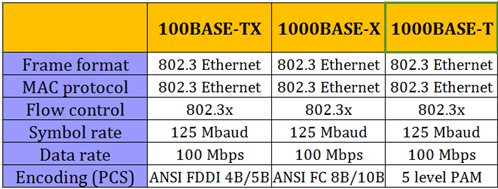
1000BASE-X supports multi-mode and single-mode fiber media and a short-reach, 25-meter copper jumper. As most of the cabling installed inside buildings today is Category 5 copper, the IEEE 802.3 1000BASE-T standard supports Gigabit Ethernet operation over the Category 5 cabling systems installed according to the specifications of ANSI/TIA/EIA-568A (1995). 1000BASE-T, however, works by using all four of the Category 5 pairs to achieve 1000 Mbps operation over the installed Category 5 copper cabling. 1000 Mbps data rates are achieved by sending and receiving a 250 Mbps data stream over each of the four pairs simultaneously.
In contrast, 100BASE-TX uses two pairs: one to transmit and one to receive. Fast Ethernet on Copper (100BASE-TX) achieves 100 Mbps operation by sending encoded symbols across the link at a symbol rate of 125 Mbaud. A 125 Mbaud symbol rate is required because the 100BASE-TX encoding scheme (called 4B/5B coding) has a bandwidth overhead of 20 percent, the difference between 100 Mbps and 125 Mbaud. Although 1000BASE-T uses a different encoding scheme (five level pulse amplitude modulation or PAM-5), because it maintains the 125 Mbaud symbol rate of 100BASE-TX, 1000BASE-T is backwards compatible with 100BASE-FX at the physical layer.
This compatibility feature is significant for network managers and planners because it means that forthcoming generations of 1000BASE-T NICs and switches will support both 100/1000 and 10/100/1000 autonegotiation between Fast Ethernet (100BASE-TX) and Gigabit Ethernet (1000BASE-T). These speed-agile products will enable network managers to deploy 1000BASE-T incrementally into the network.
Fiberstore Compatible 1000BASE-T Transceiver
1000BASE-T is a time-saving and cost-effective solution. Various products have been provided to enhance the 1000BASE-T performances.
Posted by: angelina at
06:27 AM
| No Comments
| Add Comment
Post contains 492 words, total size 6 kb.
35 queries taking 0.1253 seconds, 81 records returned.
Powered by Minx 1.1.6c-pink.

